One thing John Steinbeck* knew, traveling with a dog is an ice breaker. You meet and converse with more people when you have a dog with you. As I sat on the front porch of Stillwater’s general store a leather faced cowboy rode up on a Harley, got off and admired Sammy. After a brief conversation he said “My dog’s a hog dog”….”a catahulee”. Turns out there is such a dog, a catahoula. The only dog breed to originate in Louisiana, possibly bred by the choctaw indians. They are indeed used to work hogs, and cattle.
* Travels with Charlie, read it one summer in high school
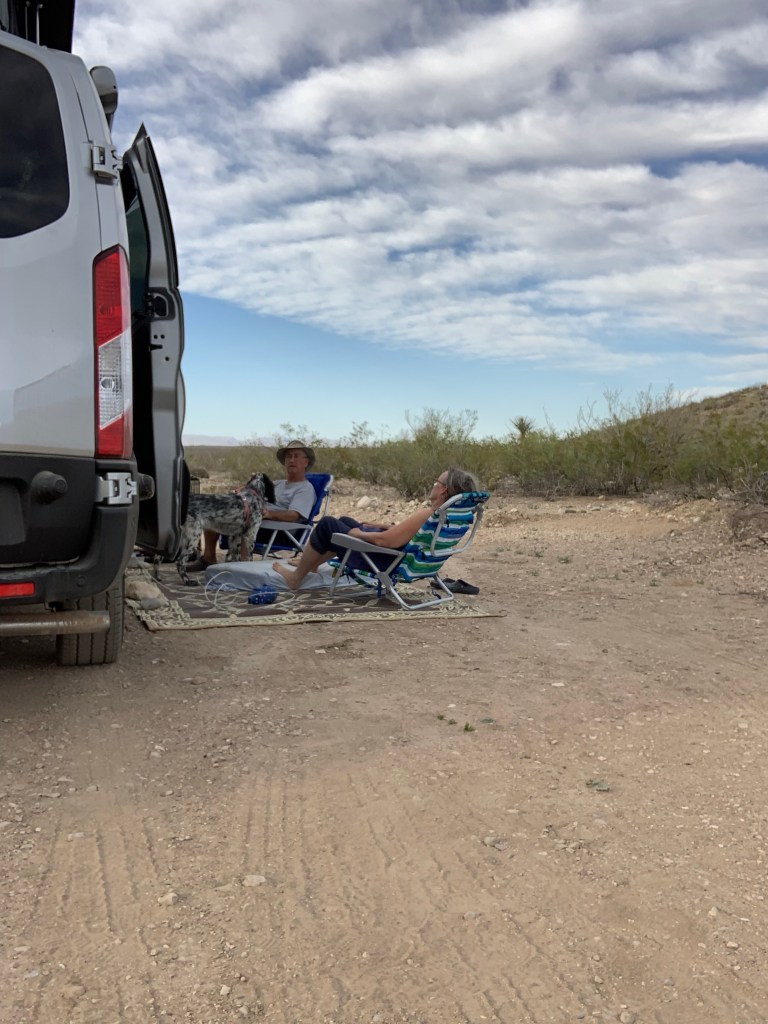
The drive Monday 3/29 from Las Cruces to Stillwater RV park was through bleak west Texas scrub country, at first on I 10, then on an almost perfectly straight ribbon of asphalt called Texas state road 90. The park was full so we chose to stay at Stillwater RV park and general store. The office/store is the converted living room of a house. Hallie Stillwater’s Hall of Fame Museum is next door, free admission but you have to get them to unlock it. The landscape was monotonous the entire drive, just west Texas desert; flat rock and gravel strewn land with occasional butte or mesa, at times high enough to qualify as a mountain. The park campgrounds are full and Stillwater RV is the closest to the entrance, plus its only $20. Here we are at our luxurious campsite…..
It’s basically a place scraped level in the desert. The store, the owner’s home really, and restroom is about 3 city blocks away. No cell phone or internet. The best part was the intense quiet, and the beautiful night sky.
New life birds here were Scaled Quail, Say’s Phoebe and Crissal’s Thrasher.
* A line from a movie that kept going though my mind as I drove 6 hours across that God awful Gene Autry country. Hat tip to anyone who knows the movie. I can’t remember it.
After Mesa Verde we decided to spend the night at a Cracker Barrel in Gallup NM. About 7 other RV’ers did the same. This was Sat 3/27. On Sunday we drove from Gallup to Las Cruces with a stop in Albuquerque’s Costco to replenish gas and propane. We ate lunch at a road food.com place, Garcia’s Kitchen. Had NM’s signature dish, Chile rellenos, then on to Hacienda RV park in Las Cruces (clean, showers great). The southern 2/3’s of NM are bleak. The highlight was seeing the many orchards along the Rio Grande. The latter is sucked almost dry by towns, agriculture and invasive water loving plants. It’s barely a stream here.
Yesterday in Moab we met an Ausiecol*. At the dog park today, 3/27 we encountered an Ausielab, and a Cowboy Corgi. The latter was really cute. The owner explained the breeder purposefully back crossed a blue healer with a welsh Corgi in order to get a corgi with longer legs. “So their belly won’t get dirty”, she explained. Both breeds are cattle dogs so the ability to herd cattle isn’t diminished.
This was the least crowded of the parks so far. Maybe because it’s not fully open until May 15, or maybe because it’s at 8,700 feet elevation and the coldest park. The Campground was closed so no chance of scoring a space. Like the other parks there is one road in but one of the many side roads off of it is quite long. Still that road was closed (Wetherill), and will be until May 15. The park’s full season is only 5 months.
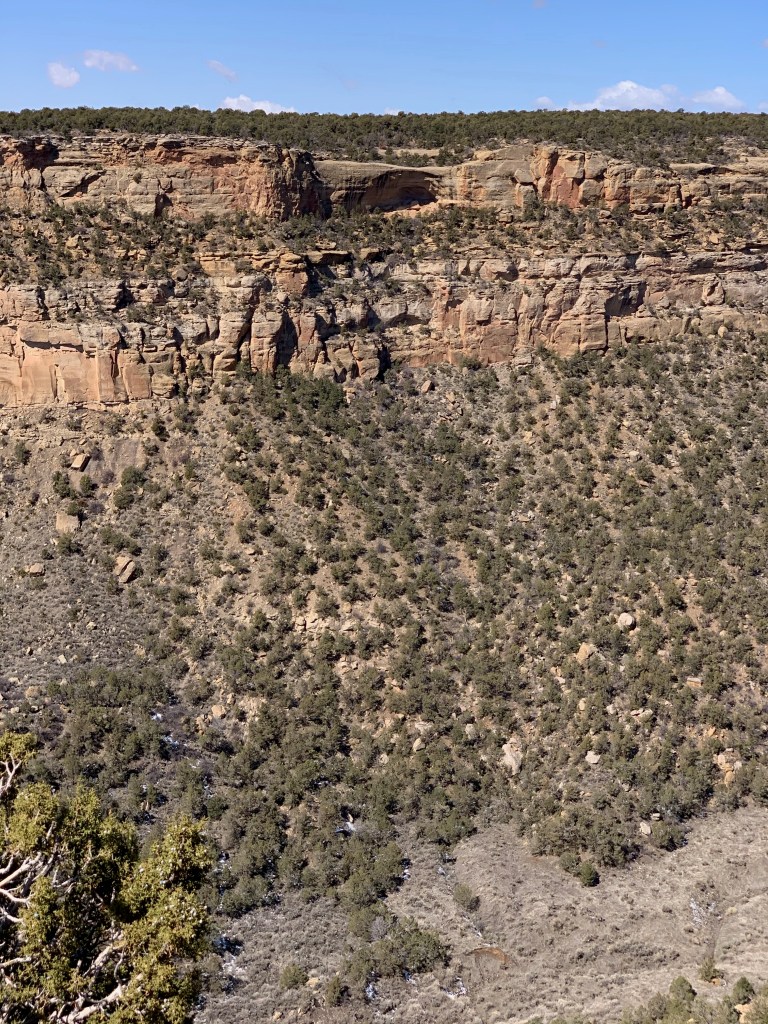
We’ve all seen pictures of the cliff dwellings. But I didn’t realize the extreme, precarious nature of the dwellings from the pictures. They seem inaccessible. Apparently the Indians used ladders, ropes and carved toe and hand holds in the cliffs in order to come and go. Imagine every day climbing a shear cliff 40 to 60 feet. Here are some pictures. The dwellings are always under an overhanging rock so are nearly always in shadow.
To the left and right is a shear vertical cliff. The canyon below is extremely rugged and steep. Another cliff dwelling. Imagine getting to it, imagine small children living there.
The rooms are small, there may be 60 rooms in the largest cluster of dwellings. Why build on the cliff, and why live at such an extreme altitude, where soil is thin and rain is sparse. The valley below, the Mancos valley where we spent the night, is around 6,500 to 7,000 feet elevation and the soil seemed decent. The mesa top where they planted the three sisters has thin rocky soil. They lived in this area from around 500 AD to 1300 AD when they abandoned it.
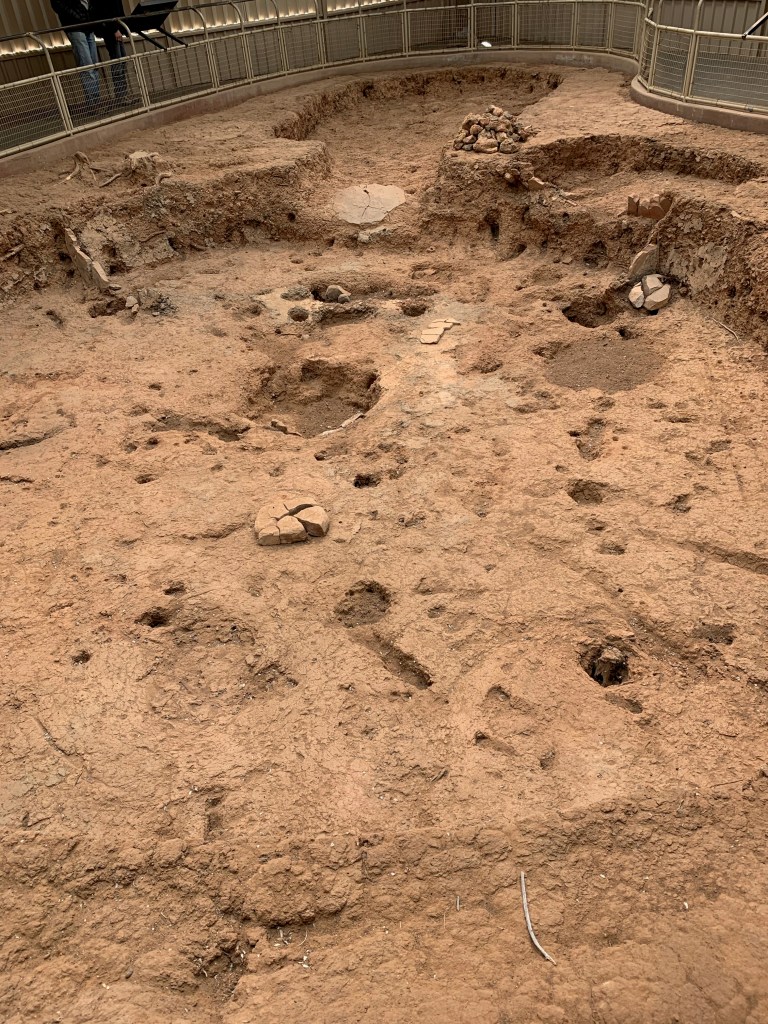
Before living on the cliffs, the earliest of these Indians lived in pit houses on top of the mesa. Here is one…..
This one was built around 700 AD. It’s 2.5 feet deep and would have been surrounded by posts with wattle and daub between them, like we see at Angel Mounds. The oval at the top of the picture was the entry way, the rectangular extension of the pit at 2:00 was essentially the pantry. Grain, dried berries and nuts, and other stable goods were stores there. That’s the actual pit with very little excavation. Later pit houses were deeper and slightly larger. The last stage of their construction was the cliff dwellings. No one understands why they moved from pit houses on top of the mesa to cliff dwellings or why they eventually abandoned them.
Two life birds added today, a Clark’s Nutcracker and a Mountain Bluebird. I’ve seen them both in the distant past but never reported them to ebird until now. Saw a probable Ferruginous Hawk but won’t report it because I’m not sure of the ID. Saw 5 species of birds total, the above 3, house finch and junco!
Finished at 3:00 PM. Took Sammy to the Cortes dog park, he loved it. Them pow wowed on tonight and tomorrow. Decided to take the plunge and go for Big Bend. We’ve had enough cold weather and aren’t quite ready to go home. We are in the parking lot of Gallup NM’s Craker Barrel. There are 6 other RV’s here Should get to Big Bend day after tomorrow.
We drove from Canyonlands to Moab to replenish groceries. Ate at a food truck (Quesadilla Mobilla), the number one rated “restaurant” in Moab on Trip Advisor. It was very good. Then we took Sammy to the dog park, he loved it, then on the road to Cortes and a Harvest Host site called Mancos Pizza. Mesa Verde is 9 minutes away. Mancos is a microbrewery. The beer we had was very good, the food was fine. The parking lot is 50/50 mud and gravel and I got stuck driving to the RV site where the gravel peters out and is mostly mud. One of the owners has a tractor out back and pulled me out. On the way here we stopped at a small park in Cortes to bird watch. Two new life birds, Cinnamon teal and Marsh Wren. Then we noticed another dog park. Sammy loves being chased by other dogs so we spent 30 minutes there before coming to Mancos Pizza. On to Mesa Verde tomorrow.
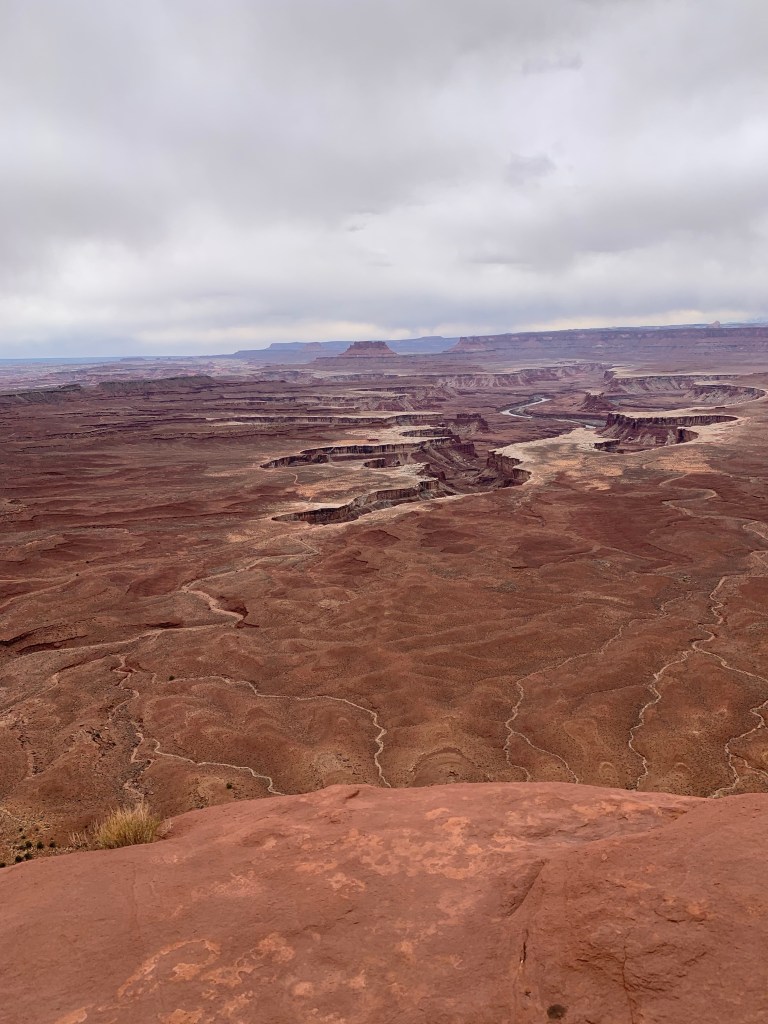
The drive from Arches to Canyonlands was only about 35 minutes. Canyonlands NP is divided into three sections by the two rivers that dominate it, the Colorado and the Green. Their confluence makes a Y that is in the center of the park. We drove into the center of the Y, called Island in the Sky. The eastern side of the Y is Needles, the western side of the Y is the maze, there are no paved roads into it. The road from the east which we took dead ends at the cliff above the rivers. The entrance to the Needles is from the south, over an hours drive from where we started at Arches. Canyonlands was the least interesting of the parks. Here is a picture of the Green river from the cliff above it.
I’m standing about 10 feet from the edge. If it looks like a wasteland or moonscape to you, it did to us too. The river turns left and meets the Colorado. There is another vista point overlooking the confluence, it looks just like this picture but you can’t see either river, they are too deep in the canyon. The La Sal mountains could be seen from Canyonlands.
The Colorado river is down there somewhere.
We got to camp inside the park again, 3 for 3 now. This time we got a spot in a first come first serve CG. The main campground is in Needles section, it requires a reservation. We didn’t go to Needles and on a whim drove through the small campground in Island in the Sky and got lucky again.
It snowed hard on the campground starting around 9:30. I was seriously worried for a while, but it only lasted about 20 minutes. All snow was a melted by 9:30 when we left.
One new bird, Juniper Titmouse. Not rare at all but I hadn’t seen one yet. The two I saw were one of only three species I saw in the park.
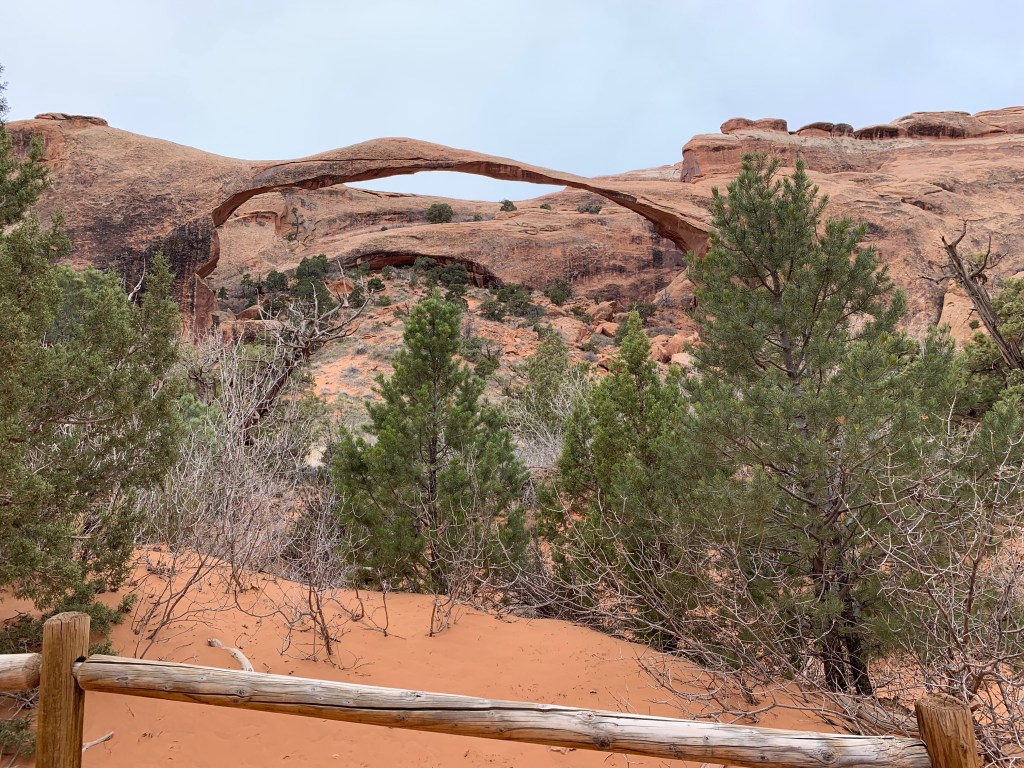
We finished seeing Arches in the morning, drove on to Canyonlands around 11 AM. The single best site at Arches was Landscape Arch….
Landscape Arch
A thin ribbon of sandstone, the trail no longer goes under it. In 1991 it did. Visitors were sitting under it when they heard cracks and loud snaps followed by falling rocks. They scurried out from under it just before 180 tons of rock from under the arch fell. It made a sound like thunder that could be heard miles away. The trail has been rerouted around the arch although the park service is considering reopening the old trail since the arch appears stable. After this we went to Sand Dune arch and then Park Avenue, then off to Canyonlands. There was a long line of cars to get into Arches, the park sure to be closed due to too many cars very soon. No new birds today.
We got to Arches early, about 8:15 AM. There is basically one road, head into the park on it and at the end of the road turn around and head out. Three or four short side roads exist. One of these is to the campground. We had planned to ‘boondocks’ tonight on BLM ground but a short drive into the campground led us to 3 open sites. Found the host and got one for the night. This despite a campground full sign and a no sites available message on recreation.gov. We’re two for two this way. Maybe our luck will hold at Canyonlands tomorrow.
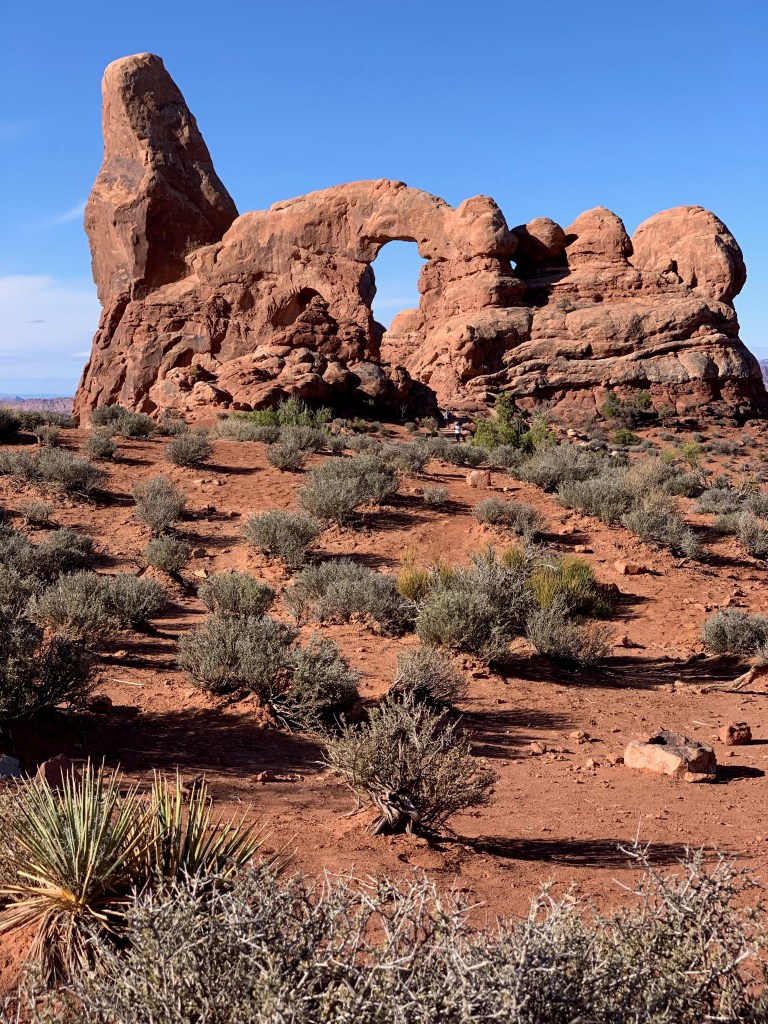
Arches is high desert, similar to the other parks but the geologic layers differ somewhat so that arches or natural bridges are more likely to be formed. When softer sandstone below erodes it leaves the harder sandstone above.
Windows, there were several of these. They are eroded holes in “fans”. Fans are the harder sandstone left after the surrounding soft stone erodes away. The windows are places where softer sandstone had insinuated itself Double arch, probably our favorite.
There were multiple variations on that theme. We had a brief spell of warmth adequate to sit outside and read or relax without bundling up. Around 4 PM it began to get cold again.
Here is our campsite. You can see we used the blocks Will gave me for Christmas to level the camper van. (people keep asking us about it, Peggy has started saying “just look it up on the ModVan website)
We took about 5 short hikes, the longest about a mile. After seeing how things work I’m sure they closed the park yesterday when the number of cars exceeded the number of parking spots at the various attractions. At double arch for example, there are roughly 75 spaces to park. We got one of the few available, and it was still only 10 AM. By noon it was hard to find a parking spot at any of them.
Tomorrow we plan to go to Canyonlands NP tomorrow and maybe snag another open spot in the “full” campground. If our luck doesn’t hold out we’ll boondocks somewhere. Day after we’ll head for Mesa Verde.
No new birds today. Actually almost no birds at all, this place is almost devoid of wildlife. Turns out water is necessary for life. I literally saw three species today, white crowned sparrows (6 of them), Ravens (numerous), and Woodhouse’s Scrub Jay (2), and one rabbit.
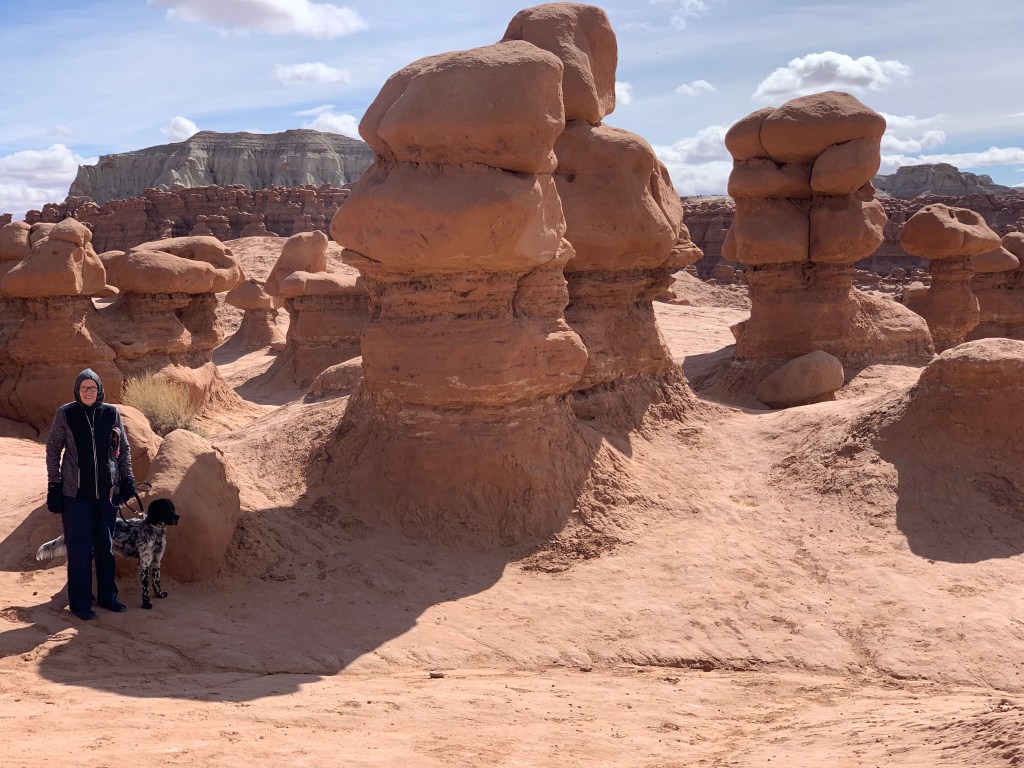
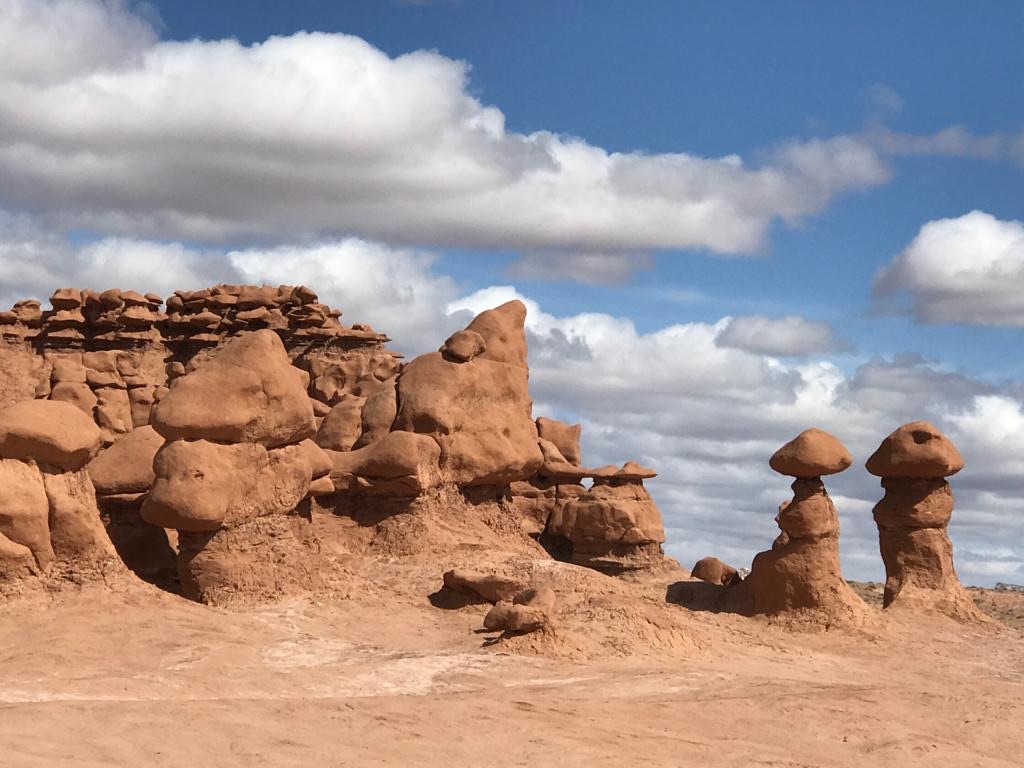
This state park was other-worldly. Pictures are in order….
The first person of European heritage to see them called this Mushroom Valley, but the Native Americans had called it Valley of the Goblins in there language, so that’s what the place eventually came to be called. Apparently this area was once a sand dune covered shore of a vast inland sea. The sand dunes were compressed into soft sandstone. As wind and water, very little water note the almost complete lack of vegetation, eroded the soft sandstone, hardened areas within the dunes remained to create these weird structures.
On the drive out of Capitol Reef I noticed a flock of small dark birds, pulled over and got a good look at about 40 Black Rosy-Finches. This is the best life bird of the trip. Look it up, gorgeous little bird. There may have been the other Rosy Finch, Gray-crowned, mixed in but I couldn’t be sure, so won’t count that species.